

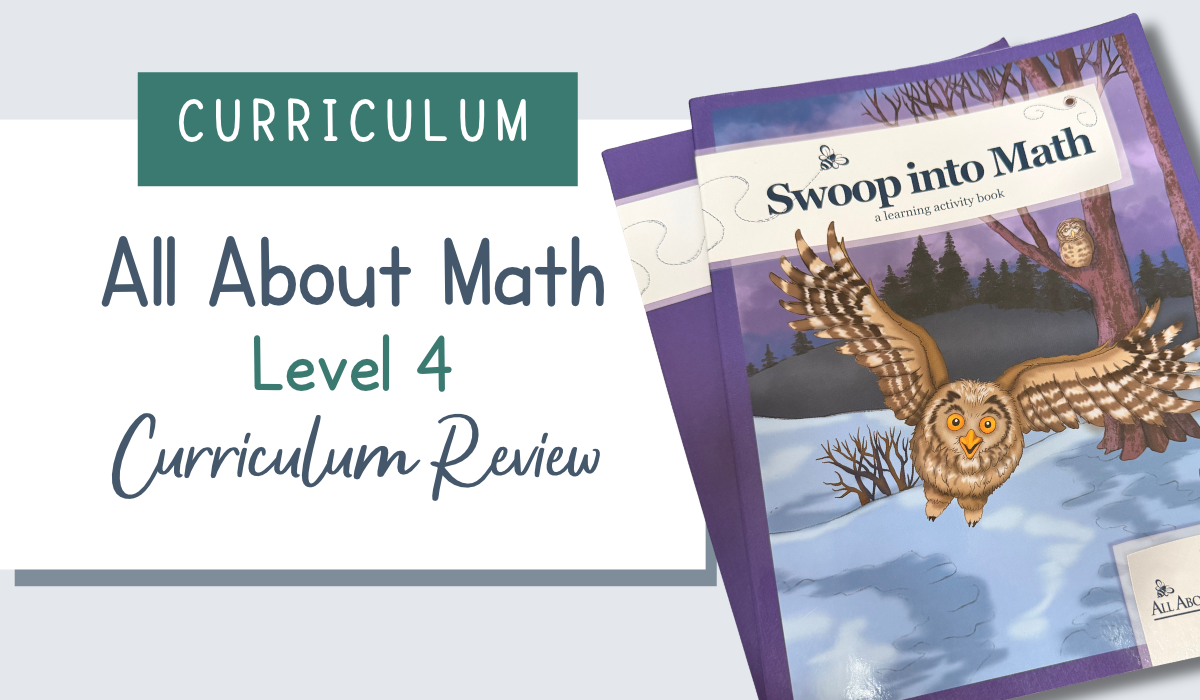
Heads up:
I received Level 4 of All About Math for free in exchange for an honest review. (However, I purchased AAM level 1 and all of their reading programs with my own money).
This post contains affiliate links. That just means, if you use one of my links to a product, I may earn a commission on that purchase, but it won’t cost you any extra money. Learn more.
I have used all 5 levels of All About Reading from this company (and reviewed it extensively) but since All About Math (AAM) is brand new, I don’t have experience teaching it.
However, as a former classroom teacher (third-grade) and a homeschooling mom of six years and counting, I enjoy analyzing curriculum and sharing my thoughts with you to help in your curriculum decisions.
All About Learning Press creates reading, spelling, and math curriculum for elementary grades, with a focus on short, hands-on, game-based lessons. Their learning programs are based on the Orton-Gillingham philosophy, which has been used effectively for years to help students with dyslexia.
Is This Level Right for My Child?
All About Math (AAM) level four is intended for a fourth grader to complete. Nevertheless, AAM says because their curriculum is mastery-based, it is not strictly for fourth grade. (Their Reading & Spelling programs are also leveled rather than grade-based.)
In addition, these lessons are not intended to be completed in one day. There are 42 lessons in level 4, some of which might take a day or two to complete while others might take a week or more.
One thing I appreciate about this approach, which is true of their reading program as well, is that you can move as quickly or as slowly as you want through any lesson or topic. So, you’re not stuck to assigned “weeks” but rather can zip through several lessons in a few days if your kid really “gets it” and then stretch out other lessons over a few weeks when they are struggling.
HOWEVER, this could be bothersome for parents who prefer a more structured approach. They assume you will just start and continue until your child completes the level. As suggested in their reading program, you should spend about 20 minutes per day and then stop and continue the next day. While it may be harder to plan out the year, it means that you never get “off track.” And honestly, most initial plans change as the year goes on anyway.
What Does Level 4 Cover?
Here is a quick run-down of some of the major concepts covered. If you want to look at them in-depth, see the links to the Table of Contents and Scope and Sequence below.
Fractions are a major focus in this level.
Decimals appear to receive a lot of attention as well.
Students practice classifying shapes.
They work on two-digit by two-digit multiplication.
Three-digit by one-digit division is also included.
And they work on multiplying fractions.
You can see a full list of the lessons in the Table of Contents PDF here.
The Scope and Sequence is also available online to view as you look into the concepts covered.
Like previous All About Math (AAM) levels, there is a QR code and website link to a short video about getting ready to teach the program. I’m not sure whether that video would be necessary for someone who has already taught previous levels, but it is available.
Level 4 continues the AAM emphasis on talking about math and verbalizing mathematical thinking. They reason that verbal discussion “deepens understanding, encourages engagement, and improves memory.”
Level 4 Placement Test
Before you purchase this book, I strongly recommend looking over their placement tests and using whichever level corresponds to your child’s current mathematical skill level.
Here is a direct link to the Level 4 Placement Test.
Using the teacher’s instructions (in yellow), work through the assessment with your child. Your child should use the student pages to answer the math problems as you go through the instructions. Answers are included in the teacher’s section.
Look over the assessment before giving it to your child, and compare the various placement tests (linked below) to see if you would prefer starting with a different level.
The Level 4 placement test includes 4 pages of instructions and 9 student pages. Just be aware so you have sufficient time to allow your student to complete it. The assessment itself is found on pages 391–399 of the Student Activity Book (called Swoop into Math).
The child completes the work in the student activity book while the parent instructs from the Teacher’s Manual, checks answers, and marks which skills were missed.
This is another section I would probably photocopy before using so that I could reuse it later with the same child and preserve a physical record of the completed assessment.
Prerequisite Skills for Level 4
This list gives you an idea of what your child should know BEFORE starting Level 4:
Reading and writing fractions
Identifying fractions on number lines
Determining equivalent fractions
Comparing fractions
Representing equal groups with multiplication expressions
Representing multiplication story problems with arrays and equations
Writing multiplication and division equations for arrays
Identifying multiplication facts and related division facts
Multiplying a one-digit number by a two-digit number
Dividing within 100
Representing and solving two-step story problems
Other Level Placement Tests:
If after looking at the list above, you want to check out a different AAM level, I’ll include links to the other levels’ placement tests.
Also, since AAM does not strictly follow “grade levels,” you may want to compare the other levels as you make your decision.
Level 1 Placement Test (The parent just reads and checks off as you consider your child’s readiness.)
Level 2 Placement Test (From this level forward the students actually participate in the placement test.)
How Is the Curriculum Set Up?
All About Math Level 4 includes a student packet, teacher’s manual (TM), and Manipulatives Kit. The manipulatives kit is necessary but you can either purchase the kit from AALP or you can create your own. The introductory sections of the TM explain all of the manipulatives used for level 4. So you could use the list to gather them yourself if desired.
There are a few additional supplies, such as a white board and markers, that are also listed - and are not included in the “kit.”
Student Packet
The Student Packet includes:
Swoop into Math: a learning activity book
Stickers (for the progress chart)
Oxley’s Math Tools (printed manipulatives, charts etc. that you will use throughout the program)
Learning Activity Book
At the front of the activity book (Swoop into Math), you’ll find a progress chart. This is where the student places their themed stickers. From using other All About Learning Press curricula, I know that you can go online and print additional copies of the progress chart for multiple children.
Level 4 includes a Daily Review Tracker. This is similar to what I’ve seen in the first three levels of AAM. It allows the teacher to keep track of the skill, date started, lessons that teach or practice the skill, notes, date mastered. As you may deduce from this tracker, AAM is a mastery-based curriculum.
For example, one skill listed is “represent equivalent fractions.” It tells you which lessons address that skill, such as “lesson 3 with models” and “lesson 7 with fractions.”
There appear to be roughly 16-20 different skills listed. I love checklists and record-keeping tools, so I think this is really nice and helpful. Some skills are broken down even further. For example, with identifying types of angles and triangles, there are individual checkboxes for the different angle types. You can check each of these off as the student learns them and then record the final mastery date once all the angles are mastered.
Teacher’s Manual
General Organization
The Level 4 Teacher’s Manual has about 30 pages with information about Preparing for Level 4, nearly 500 pages of complete step-by-step lesson plans, and several appendices in the back.
This general structure is similar to the previous levels. The Teacher’s Manual is very step-by-step. Lessons are divided into: New Concept Lessons and Progress Monitoring Lessons.
The Progress Monitoring Lessons review and practice previously taught concepts.
The Parts of a Lesson
Before You Begin
Each lesson begins with a yellow box that is specifically for the teacher. It will tell you what objective is taught in that lesson as well as what materials you will need to gather (math kit supplies, page numbers, etc.). This section also lists any new math vocabulary for that lesson.
Finally, this yellow box has a section called “Before You Begin.” I really appreciate the teaching tips that they provide in this for each week. If you are new to teaching math or haven’t done 4th grade math in decades, it can be invaluable. This information ensures you know what to expect of your child in the upcoming lesson. It also shows you how the current lesson bridges the gap between past and future lessons.
Review
Starting in Lesson 3, students complete short Math Practice pages. These “worksheets” are designed to review and keep skills fresh. They intentionally are quick and focused so the child builds confidence.
Starting in lesson 7 they also add a review section called Daily Review. For this, they want you to refer to the Daily Review Tracker and choose one or two skills to practice. It appears that even if a lesson takes a week to complete, you would still review 1-2 of the concepts from the tracker each day you worked on it, whereas the Math Practice page would be a one-time page. Sometimes they include an additional review activity that prepares the child for the new lesson. It doesn’t have a “title” of its own other than the actual name for what it is (i.e., Modeling Fractions, Drawing Shapes).
New Teaching
Following the Daily Review, Math Practice, and any additional review that they include prior to the lesson, you begin the New Teaching. This section includes a script, in quotes, so that the parent-teacher can simply read the page to their student rather than having to prepare ahead of time what to say. It also includes the correct answers to any questions asked or samples of what to expect in a reply from the student.
I appreciate that this section also includes small copies of all pages used from the student activity book or Oxley’s math tools. This makes it very easy to find what you are supposed to be using. When applicable, an answer key is also included. Often it is a list of answers, but when needed they print a smaller version of the page and superimpose the answers on top of it in pinkish-red ink. So you don’t have to hunt for a separate answer key!
The New Teaching section is typically several pages long. Again, it is not intended to be completed in one day. So, you can easily stop when 20 minutes are up. Then resume where you left off the next day.
Within the New Teaching, they include a few other sub-sections: activity sheets, math reflections, and optional extended practice.
Activity Sheets
The activity sheets come from the Swoop into Math (student activity) book. Each lesson includes one or more pages with written activities for the student to complete to reinforce the lesson’s concepts. These are intended to be torn out of the student book and written on.
Math Reflection
At the end of each lesson, the parent is given questions to guide the student’s reflection. For example, you might ask: What topic is your favorite? What was something you found easy? What do you want more practice with? They are often open-ended questions, which fits with the discussion-based approach of this series.
Extended Practice (Optional)
If the student is still struggling with the concept after completing the lesson, AAM provides some additional practice to reinforce the skill. This is for you to use at your discretion. You will likely find that you only need to use it for some lessons but not others.
Oxley’s Math Fun
Following the “New Teaching” section of each lesson, students get to play a game. The Oxley’s Math Fun pages are included in the student packet (alongside the activity book). These activities are printed on durable cardstock so that they can be used again as a practice or review. These often involve cutting out cards to be used for a game. Answer keys are provided as applicable.
Track Your Progress
Once you have completed the lesson, students get to put a sticker on the Progress Chart. This is a fun way for children to visualize how far along they are in the program. Again, since there are 42 lessons, they will get to put approximately 1-2 stickers on the chart per week.
What to Expect from Level 4
Early Lessons
Level 4 begins by reviewing concepts from the previous book, such as:
Digits in the ten-thousands place
Digits in the millions place
Multiplying a two-digit number by a one-digit number
Dividing a two-digit number by a one-digit number
Writing multiplication equations to represent situations or stories
Writing multiplication and division equations to represent situations
Lesson 2 begins working with fractions
Written Work
The Swoop into Math: a learning activity book (Student Activity Book) asks students to draw, write, label, circle, and cut out materials. There is definitely more “writing” than in the first level of the program, so they may be trying to add this as the student grows.
You could probably put many of these pages into a page-protector and use a thin dry-erase marker so they could be reused for multiple children. If you want a permanent physical record of the child’s work, you would probably want to purchase another activity book for the next child. The copyright states that the individual purchaser has permission to photocopy student materials for non-commercial, individual household use. But the pages are very colorful, and I would not find it worth my time and money to copy each one. However, you could only copy certain pages, like the review activities.
I can see some parents looking at this curriculum and being turned off by its unconventional approach, thinking that there is not enough written work because it’s not set up in a “workbook” style. However, there is written work within the New Concept Lessons when appropriate, as well as the Math Practice pages.
However, the curriculum clearly continues the company’s strong emphasis on games, manipulatives, hands-on learning and verbal interaction. I think this could be especially good for kids who feel overwhelmed by long worksheets or who specifically need a more verbal and hands-on approach.
I don’t think any one curriculum is perfect or a great fit for everybody. The benefit of homeschooling is being able to create a “bespoke” education for each of your children. So, knowing the styles in which they each learn best and then adapting to that as you are able is unique to homeschooling.
One of the reasons I chose and loved All About Reading with my kids was their hands-on approach. I see that multi-sensory style of learning continuing in their math program. For instance, as they study fractions, students cut out fractions and representations of fractions using fraction bars. There is a “Pizza Party” activity involving fractions, along with other games and activities. This program is colorful, bright, manipulative-based, hands-on, and game-based.
Throughout the book they include Story Problems and Situation pages, designed to help students engage with real-world math. They appear frequently throughout this level, which I appreciate. The problems used in these lessons are written out so that the child can read along or out loud, underline important numbers or questions being asked, and mark anything else that helps make sense of the problem. I love this strategy since it is so similar to how adults approach real-life problems we face.
Lesson Structure and Pacing
It is very important to understand that in All About Learning Press curricula, whether reading, spelling, or math, one lesson does NOT equal one school day. AAM level 4 continues to suggest spending about 20 minutes on math at a time. They recommend setting a timer and stopping when the time is up. I know that does not fit every educational methodology, but I can see a lot of value in it. In fact, even adults struggle to pay attention for longer than 20 minutes at a time.
Even at ages 9–10, children get tired and frustrated fairly quickly. Once a child is frustrated or disengaged, learning becomes much harder. I appreciate the idea of keeping the sessions manageable rather than insisting that an entire lesson be completed. This allows you to be more productive during your math time, as your child is actually able to focus for a brief but intense period of time.
This may bother some parents, particularly if you really want a curriculum where every day corresponds neatly to one numbered lesson.
However, one benefit of this approach is that if you miss a day due to sickness, etc., it doesn’t throw off your year. You are not tied to completing 5 lessons per week.
In conclusion, All About Math Level 4 is a flexible, hands-on program with a strong focus on games, manipulatives, and math discussion. Its scripted teacher’s manual and skills mastery tracker may appeal to families who like guided instruction with a pace tailored to the child. The flexible schedule and lighter workbook format would be particularly helpful for students who struggle with or resist written work. Since I haven’t taught Level 4 myself, I recommend reviewing the placement test and scope and sequence to decide whether it fits your child.
Further Reading
Still wanting to learn more about All About Math? Taking a look at my deep dives into the other levels will give you a fuller picture of this program.
All About Math Level 5 Review (coming soon)
Interested in this fun game-based approach to teaching reading? Check out my extensive articles on All About Reading on this page: